Pumas Fall Short Again in Dublin Against Resilient Ireland

"Argentina's quest for victory in Dublin continues to haunt them, as the Pumas showcase resilience and tactical prowess against a formidable Ireland, leaving them with lessons learned and a spirit ready to conquer next time."
For Argentina's Pumas, Dublin continues to be an impenetrable stronghold—an ongoing flaw in an otherwise remarkable record of away victories. After overcoming powerhouses like the All Blacks in Wellington, Los Pumas stepped onto the field at the Aviva Stadium with aspirations of changing their fortunes in Ireland. However, the story of Felipe Contepomi's team would once again be characterized by close calls and critical errors as Ireland, recovering from a recent loss, managed to hold strong for a hard-fought victory.
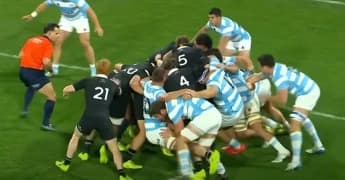
The initial phase of the match held the promise of thrill and uncertainty. An intense opening showcased Ireland's defensive strength as they charged down two early kicks. Yet, it was Argentina that made the first move, quieting the crowd just two minutes in with a skillfully executed try from inside centre Matías Moroni. His score surprised Ireland, but the following moments would prove crucial. A head collision—one of those debatable instances where rugby's constantly changing safety regulations collide with interpretation—resulted in a yellow card for Moroni. Although replays revealed that both the tackler and the tackled were in vulnerable positions, the ruling remained, and Argentina's numerical disadvantage became the critical factor.
With the Pumas reduced to 14 players, Ireland exploited the opportunity with clinical efficiency. They scored two tries in rapid succession, significantly shifting the momentum in their favor. A third try seemed imminent but just slipped through their fingers, giving Argentina a faint hope. Nonetheless, the visitors demonstrated remarkable resilience. Their defensive efforts—a key aspect of Contepomi’s coaching philosophy—ensured that they kept the score gap manageable as they neared halftime.
The second half began with a significant alteration as scrumhalf Gonzalo García took the place of the underwhelming Bertranou in the 45th minute. This change brought a new rhythm to the game; García's vigor facilitated quicker ball distribution, enabling Santiago Carreras to have a greater impact. The young fly-half from Tucumán has been a central figure in Argentina’s tactical discussions this season. During the match, Carreras showcased his abilities with moments of creativity and relentless defensive efforts, although opportunities were scarce.
What followed was a performance that highlighted Contepomi’s vision for the Pumas: unyielding in both offense and defense. The second half revealed Argentina’s distinct intensity—continuous pressure, sharp line speed, and forceful ball carries. However, Ireland, as they frequently do on home soil, discovered ways to weather the storm and respond effectively. The moments when luck smiled on the hosts arose not from overwhelming dominance, but rather from those elusive instances where perseverance intersects with opportunity.
Despite Argentina's commendable efforts, they were hampered by the slimmest of margins: two yellow cards, a few missed opportunities, and a failure to completely breach Ireland’s disciplined defensive line. The Pumas showed that the vision under Contepomi is indeed promising—a strategy that blends passion with tactical intelligence. However, the harsh truth is that, at the highest level of competition, consistency and precise execution are absolutely essential.
When the final whistle blew, the supporters at Aviva in Ireland let out a sigh of relief. For the Pumas, although there was a sense of pride in their performance, it was accompanied by the familiar disappointment of a missed opportunity. The jinx in Dublin remains intact, yet there are valuable lessons to learn from this experience. Contepomi's squad will return, and when they do, they will be a team sharpened by experience, prepared to take on history once again.