
"Medvedev vs. Sinner: Adapting in an Evolving Rivalry"
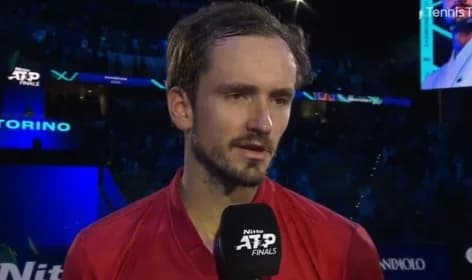
As Daniil Medvedev faces the rising star Jannik Sinner, the evolution of their rivalry highlights the crucial need for adaptability in elite tennis, testing Medvedev's strategies and mental resilience in this dynamic matchup.
In recent times, Daniil Medvedev has found himself in the midst of Jannik Sinner’s rapid development. Previously commanding in their rivalry, Medvedev is now up against a more complete and aggressive iteration of the young Italian, who has reversed their head-to-head outcomes. As the dynamics of their rivalry change, one must wonder: can Medvedev reclaim the advantage over a player who appears to have figured out his style of play?
During the initial phases of their rivalry, Medvedev was the key player, utilizing his characteristic deep-court positioning and exceptional defensive skills to keep Sinner at bay. The Russian's gameplay exemplified consistency and patience, frequently leading Sinner into rallies rife with errors and taking advantage of the Italian's moments of impatience. Medvedev's prowess in enduring lengthy exchanges and his ability to force opponents into making mistakes placed him in a strong position, granting him a six-match advantage in their head-to-head record.
In recent years, Sinner's growth has been nothing short of revolutionary. The Italian, once mainly recognized for his sheer power and dominance from the baseline, has now blended precision, aggression, and flexibility into his playing style. Where he previously found it difficult to penetrate Medvedev's defenses, Sinner has learned to strike the ball earlier, take command of rallies, and confidently approach the net to conclude points. His enhanced first serve and more refined strategic approach have turned him into a formidable competitor, leaving Medvedev on the defensive as he attempts to adjust to a Sinner who no longer falls into his tactics.
Sinner's strategy of taking control early in rallies has dramatically changed the game dynamic. By positioning himself closer to the baseline, he has effectively neutralized Medvedev's deep-court style, reducing the Russian's time to react and pushing him into a defensive stance. Sinner's aggressive gameplay, paired with his capability to finish points at the net, has made Medvedev's usual long-rally tactics much less effective. Sinner’s forehand, which used to be a devastating weapon, has now become a means of dictating the flow of play, leaving Medvedev struggling to establish his rhythm against it.
Sinner has refined his return game, applying greater pressure to Medvedev's serve than at any time previously. With a more diverse serving strategy, Sinner has complicated Medvedev's ability to gain momentum, compelling the Russian to constantly chase points during rallies.
In order to effectively confront this enhanced version of Sinner, Medvedev will need to adjust his strategies both tactically and psychologically. While his tendency to position himself deep behind the baseline has proven beneficial against numerous opponents, it has become a disadvantage against Sinner. The Italian's early striking and capability to take control of rallies leave Medvedev with minimal time to adjust, often putting his defensive shots under pressure. To break Sinner's rhythm, Medvedev should think about stepping inside the baseline more often, especially on his serve and during rallies, thereby limiting the time Sinner has to prepare for his assaults.
Medvedev has consistently been recognized for his patience and his skill in wearing down opponents. However, when facing a player like Sinner, who is adept at long rallies, he may need to adopt a more aggressive, first-strike approach. By flattening his shots and aiming for winners earlier in the exchanges, Medvedev could disrupt Sinner's rhythm, pushing him into more defensive scenarios that Medvedev can exploit.
An additional aspect where Medvedev can disrupt the flow is through his serve. Although it remains one of the most powerful on the tour, Medvedev's serve has proven to be less effective against Sinner in their recent matches. To gain an advantage, Medvedev could diversify his serving strategies, employing body serves to disrupt Sinner’s returns and frequently targeting the Italian's backhand. Additionally, varying spin and pace will be crucial for throwing Sinner off his rhythm.
Although Medvedev favors baseline rallies, he still has the ability to catch Sinner off guard with some occasional net approaches. By incorporating more variety into his game and utilizing well-placed drop shots, Medvedev can keep Sinner on his toes and disrupt his ability to establish a dominant rhythm from the baseline.
Although the tactical changes are essential, Medvedev's mental mindset will hold equal significance. The change in their head-to-head standings might shake his confidence, yet the Russian needs to concentrate on maintaining his composure and avoiding fixation on prior defeats. Each encounter with Sinner will serve as a chance to refresh and implement his new strategies without being hindered by the memories of past losses.
The competition between Medvedev and Sinner has swiftly evolved into one of the most fascinating on the ATP Tour. With Sinner's continuous advancement and Medvedev's exceptional tactical insight, it represents a showdown between two athletes at the peak of their careers. As they face each other more frequently, the ultimate challenge will lie in Medvedev's capacity to adapt. Should he accept a more aggressive approach, revise his court positioning, and maintain mental strength, there are ample reasons to believe he could shift the rivalry back in his favor.
In the world of elite tennis, the ability to adapt frequently distinguishes champions from challengers. Within this developing rivalry, Medvedev possesses the necessary skills to make a comeback. His success in regaining his winning form will hinge on his capacity to evolve alongside Sinner – a feat achievable only by the most experienced champions.